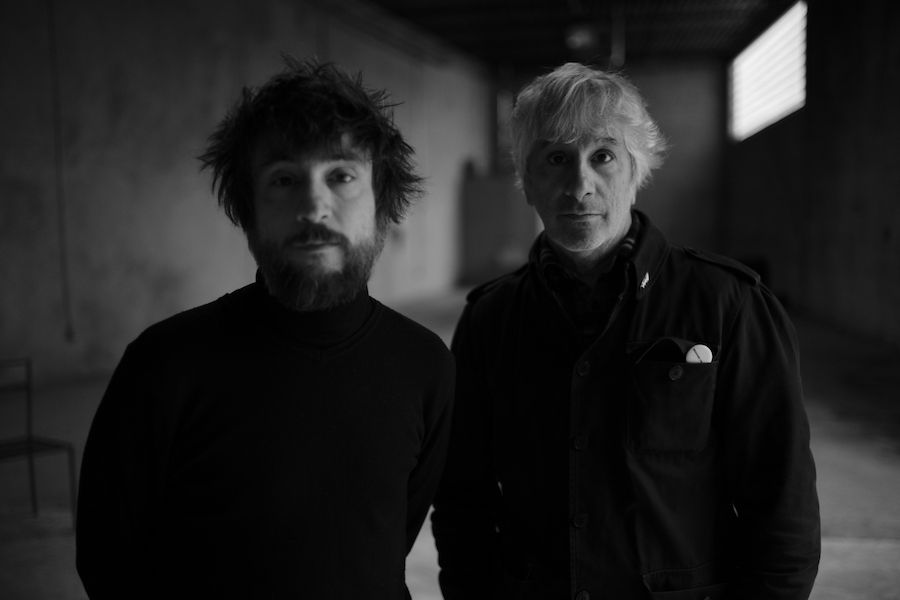
LEE RANALDO & RAÜL REFREENew York
“If you live long enough, you see a lot of people drift in and out of your life,” says Lee Ranaldo, explaining one of the loose themes linking the adventurous pieces that compose his and collaborator Raül Refree’s electrifying new album Names Of North End Women: that of the ineffable course of time, and the lives that pass in and out of one’s own.
In a remarkable career that has seen him flourish as a songwriter, a singer, a guitarist, a noisemaker, a poet, a visual artist, a producer, and more, Ranaldo has seen many fellow quixotics – his bandmates in Sonic Youth, composer Alan Licht, filmmaker Jim Jarmusch, author Jonathan Lethem, partner Leah Singer, drummer William Hooker – pass through his life, their collaborations changing the path of his work. One such resonant encounter occurred in 2014, as Ranaldo and his band The Dust found themselves adrift for a week in Spain, after a proposed festival in the Moroccan desert fell through at the last minute.
The group relocated to a Barcelona recording studio to cut an album in the “unplugged” set-up they’d latterly been performing in, yielding the 2014 album Acoustic Dust. The producer for the session was Raül Refree, whose restless career had taken him from hard-core bands in his youth, to the vanguard of a new movement redefining flamenco. One of the most renowned producers in southern Europe, his duos with Rosalía, Richard Youngs, Lina, Sílvia Pérez Cruz, as well as his collaborations with a wide range of International artists (Cheikh Lô, Mala Rodríguez, C Tangana, Josh Rouse, Rocío Márquez) and his award winning work composing soundtracks (most notably with Isaki Lacuesta) exhibit the scope of his approach. Ranaldo sensed an instant kinship with Refree, and friendship blossomed, alongside plans to work together again in the future.
The first fruits of that collaboration, 2017’s Electric Trim, began during a week or two with Refree in New York, and continued as the duo sent each other ideas and recordings over the year that followed. Ranaldo describes Electric Trim as, “The beginning of this journey of leaving the idea of a ‘band’ behind, Raül and I taking my demos and building the tracks in the studio.” This more experimental approach to Ranaldo’s songs yielded the finest yet of his solo albums – though, he says, Electric Trim was “still a record of songs you could imagine a band going out and playing live.”
Names Of North End Women, however, is a landmark further step in that journey. Where the previous album had begun with Ranaldo’s demos, for these new sessions Refree and Ranaldo composed and improvised in the studio together, building tracks up from scratch. Their reference points, Ranaldo says, “were more in the electronic or contemporary music landscape: Ryuchi Sakamoto, Arthur Russell, Conlon Nancarrow, or Steve Reich. We knew we weren’t making a ‘rock’ record – we approached it as if we were making experimental music. For thirty years of Sonic Youth and my first two solo records, I was working in the same format: two guitars, bass and drums. And Raül’s idea was, ‘Let’s treat your songs in a different way – different rhythms, different textures, different instrumentation.’”
Freed of the pressure of how they might reproduce the new tracks live, Refree says, allowed them to focus on “the precise moment we’re recording”, and to “lose the limits” on where that creative moment might take them. It is, Ranaldo notes, an album that features tracks with little or no guitar, “and that right there is a pretty big step in a new direction”. Instead, they composed using marimba and vibraphone, using samplers, a vintage 2-inch Studer tape recorder, and a modified cassette machine Ranaldo played in performance 25 years earlier. They employed the studio as both instrument and woodshed, building and rebuilding and re-rebuilding tracks that would often be unrecognisable on Thursday from how they’d begun on Monday.
“We were mixing in all these strange analogue sounds from old cassette tapes, dealing with tape hiss; using very new technology and very old technology and mixing them together,” remembers Ranaldo. Elements from a mysterious old tape Ranaldo found spooled on the Studer when he’d bought it years earlier – drum sounds, slamming doors, people talking – formed the backbone of what would become the haunting, resonant ‘Humps’. The music, it seemed, could come from literally anywhere.
Quickly, the duo realised they weren’t recording a new Lee Ranaldo solo album, but rather their first as Lee Ranaldo and Raül Refree – “the beginning of a new partnership, a new configuration’”, Ranaldo says. “We’re a two-headed machine,” adds Refree. “We’re both talking about everything. We don’t always agree on everything, but every song, every piece, every sound you hear comes from two people talking about it.”
The aim wasn’t to write traditional songs. “This record began as playing with samplers and cassette players,” says Refree, “as experimental music, musique concrete, poly-rhythms.” As the process wore on, however, their abstractions materialised into songs, their elemental rhythms, ambient hums and sampler damage revealing hidden melodies and patterns upon deep listening. Ranaldo and Refree traded melodic ideas and added vocals to the tracks, singing in addition to the spoken word pieces they’d always planned these pieces to feature. The words came in a process akin to the music, a collagist philosophy prevailing, as Ranaldo recomposed poems from his archives, wrote new pieces and incorporated lines sent in by Jonathan Lethem – who’d helped pen the songs of Electric Trim. Recording his vocals, Ranaldo would surround himself with numerous music stands loaded up with these lyrical sources, drawing random lines from across them to see what fit each song.
The result is startling, an album that diverges sharply from the more traditionalist set-up of Ranaldo’s recent string of solo albums, alive with the electric crackle of experimentalism, yet satisfying as a collection of songs. On the more adventurous, abstract tracks – the static pulse of ‘Words out of the Haze’, the discordant chimes of ‘New Brain Trajectory’, the meditative gongs and bristles of the title track – unlikely crescendos, half-submerged hooks and bruised pop moments surface unexpected. The more traditionally song-oriented pieces – the melancholic, piano-anchored ‘The Art of Losing’, the sad, sweet closer ‘At The Forks’ – are wired with a sense that in any second they might erupt into grand, cacophonic piano chords or train whistles, that the guitar track might skip or slide backwards. The tantalising sense of the unexpected never abates, and neither does the sense of new ground being broken, even as Ranaldo’s burr remains as recognisable as ever.
The album’s title, and the title of the lead track came from an experience Ranaldo had walking through a neighbourhood in the North End of Winnipeg, Manitoba (the setting for ‘At The Forks’ as well). All the streets were named after women: Lydia, Kate, Dagmar, Harriett, Juno, etc – but first names only, which implied something anonymous, or universal. Who these women are or were is not indicated, which lends their choice a certain mystery… Men are often named in our society with their full names, but these anonymous names were perhaps stand-ins for the many unrecognised or un-specified in our society. Ranaldo jotted the names down, in poem format, and explains, “somehow it became an impetus for the lyrics in terms of the people that drift in and out of one’s life, some significant, some fleeting.” He continues, “I had this idea of using given names as a device that could inform some of the lyrics. It doesn’t play through all the lyrics, but quite a few employ this idea.”